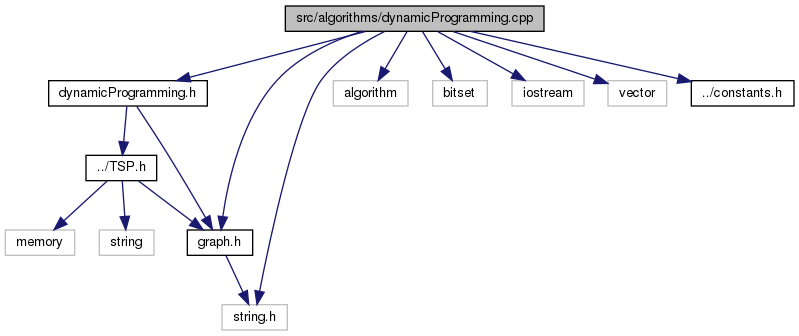
#include "dynamicProgramming.h"#include <string.h>#include <algorithm>#include <bitset>#include <iostream>#include <vector>#include "../constants.h"#include "../graph.h"
Diagrama de dependências de inclusão para dynamicProgramming.cpp:
Funções | |
| void | getSolution (vector< vector< int >> &memoTable, int citiesSubset, int endingCity, int numCities, int *cities) |
| Discover what is the best solution Dynamic Programming found. Mais... | |
| bool | notIn (int subset, int city) |
| Checa se uma cidade não está no subconjunto. Mais... | |
| int | removeCity (int city, int subset) |
| Remove uma cidade do subconjunto de cidades. Um subconjunto é uma sequência de bits. Mais... | |
| int | dynamicTSP (vector< vector< int >> &memoTable, double **graph, int citiesSubset, int endingCity, int numCities) |
| void | initMemoTable (vector< vector< int >> &memoTable, double **graph, int numCities) |
| Populate memoTable with know values from the graph. For example, for the empty cities subset (0), if I consider the ending city as 1, then, the cost to pass through this path is the cost to go from city 1 to city 0 that is the starting and ending city. Mais... | |
| int | dynamicTSP (double **graph, int numCities, int *cities) |
| Solve the Travelling Salesman Problem using Dynamic Programming. Mais... | |
Documentação das funções
◆ dynamicTSP() [1/2]
| int dynamicTSP | ( | vector< vector< int >> & | memoTable, |
| double ** | graph, | ||
| int | citiesSubset, | ||
| int | endingCity, | ||
| int | numCities | ||
| ) |
Given a set of cities and an ending city in this set, returns the minimum cost to reach it passing through all cities in the set.
- Parâmetros
-
memoTable Table were the rows are acessed via an integer number that represents the subset of cities (Ex.: 1110 = 14 would represent a set with cities 1, 2 and 3. Each 1 represent a city in the set) and the columns are also acessed via an integer number that represents the desired ending city. So, memoTable[14][0] will represent the minimum cost to reach city 0 passing through the cities in the subset {1, 2, 3}. graph Hamiltonian graph. citiesSubset The subset of cities this function will analyze. endingCity A city in the subset that will be the last in the path. numCities Total number of cities.
- Retorna
- The minimum cost to reach the endingCity passing through all cities in the citiesSubset.
◆ dynamicTSP() [2/2]
| int dynamicTSP | ( | double ** | graph, |
| int | numCities, | ||
| int * | cities | ||
| ) |
Solve the Travelling Salesman Problem using Dynamic Programming.
- Parâmetros
-
graph Given graph. numCities Number of cities (number of vertices of the graph). cities Pointer to an array to store the sequence of cities of the best solution.
- Retorna
- int The cost of the best solution.
See dynamicTSP() documentation above to understand this table
◆ getSolution()
| void getSolution | ( | vector< vector< int >> & | memoTable, |
| int | citiesSubset, | ||
| int | endingCity, | ||
| int | numCities, | ||
| int * | cities | ||
| ) |
Discover what is the best solution Dynamic Programming found.
- Parâmetros
-
memoTable Table were the rows are acessed via an integer number that represents the subset of cities (Ex.: 1110 = 14 would represent a set with cities 1, 2 and 3. Each 1 represent a city in the set) and the columns are also acessed via an integer number that represents the desired ending city. So, memoTable[14][0] will represent the minimum cost to reach city 0 passing through the cities in the subset {1, 2, 3}. citiesSubset The subset of cities this function will analyze. endingCity A city in the subset that will be the last in the path. numCities Total number of cities. cities Pointer to an array to store the sequence of cities of the best solution.
◆ initMemoTable()
| void initMemoTable | ( | vector< vector< int >> & | memoTable, |
| double ** | graph, | ||
| int | numCities | ||
| ) |
Populate memoTable with know values from the graph. For example, for the empty cities subset (0), if I consider the ending city as 1, then, the cost to pass through this path is the cost to go from city 1 to city 0 that is the starting and ending city.
- Parâmetros
-
memoTable Table were the rows are acessed via an integer number that represents the subset of cities (Ex.: 1110 = 14 would represent a set with cities 1, 2 and 3. Each 1 represent a city in the set) and the columns are also acessed via an integer number that represents the desired ending city. So, memoTable[14][0] will represent the minimum cost to reach city 0 passing through the cities in the subset {1, 2, 3}. graph Hamiltonian graph. numCities Total number of cities.
◆ notIn()
| bool notIn | ( | int | subset, |
| int | city | ||
| ) |
Checa se uma cidade não está no subconjunto.
- Parâmetros
-
city Índice da cidade a ser checada. Considerando que a city 0 seria a última à direita (Little Endian). subset Subconjunto de cidades. Ex.: subset = 14 = 1110 (cidades 1, 2 e 3)
- Retorna
- true caso a cidade não esteja no subconjunto. Ex.: notIn(14, 0) = true.
- false caso contrário.
◆ removeCity()
| int removeCity | ( | int | city, |
| int | subset | ||
| ) |
Remove uma cidade do subconjunto de cidades. Um subconjunto é uma sequência de bits.
- Parâmetros
-
city Índice da cidade a ser removida. Considerando que a city 0 seria a última à direita (Little Endian). subset Subconjunto de cidades. Ex.: subset = 14 = 1110 (cidades 1, 2 e 3)
- Retorna
- int O novo subconjunto com a cidade removida. Ex.: removeCity(2, 14) = 10 = 1010